Model for palletizing and heavier tasks where you need more payload and more reach
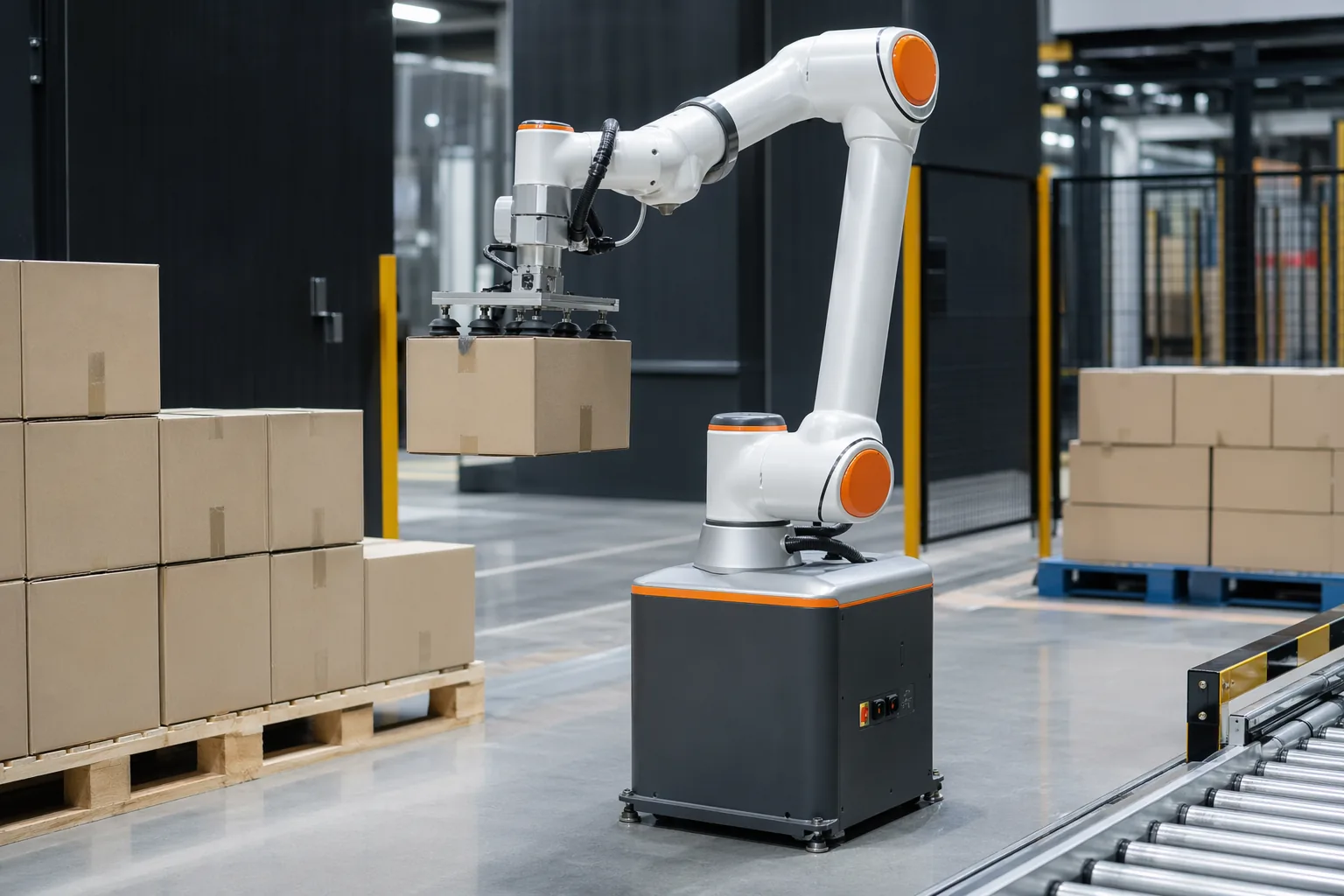
| Payload | 20 kg |
| Reach | 1700 mm |
| Repeatability | ±0.05 mm |
| Degrees of freedom | 6 axes |
| Robot weight | ~45 kg |
| Protection class | IP54 (IP65 optional) |
| Joint J1 | ±360° @ 120°/s |
| Joint J2 | ±360° @ 120°/s |
| Joint J3 | ±165° @ 120°/s |
| Joint J4 | ±360° @ 150°/s |
| Joint J5 | ±165° @ 150°/s |
| Joint J6 | ±360° @ 180°/s |
| Interface | 10.1" Tablet / Web App |
| Communication | Ethernet, Modbus |
| I/O | 16 DI, 16 DO, 2 AI, 2 AO |
| Programming | C#, C++, Python, Java, ROS |
| Power supply | 100-240V AC, 50/60Hz |
| CE | Directive 2006/42/EC |
| Safety | EN ISO 10218-1 |
| Design | EN ISO 12100 |
| Electrical | EN 60204-1 |
| Control | EN ISO 13849-1 |
Manu 20 makes sense when the process has already grown beyond Manu 10 in payload, reach or part size.
Palletizing heavier products, boxes or layers where reach and stable handling are critical.
Welding larger structures and parts when torch setup and work envelope are too demanding for Manu 10.
Moving heavier components between operations without building a fully custom industrial robot cell.
Handling larger machine tools and heavier detail where cycle stability matters more than compact footprint.
Finishing larger surfaces or parts that need both reach and controlled contact.
Assembly and handling of heavier components where Manu 5 and Manu 10 no longer leave enough margin.
We will verify whether Manu 20 is really needed, or whether the same process can still be handled more efficiently with Manu 10.